

Survey Data
Reg No
60260168
Rating
Regional
Categories of Special Interest
Architectural, Artistic, Historical, Social
Original Use
Country house
Date
1800 - 1805
Coordinates
325493, 220432
Date Recorded
14/11/2012
Date Updated
--/--/--
Description
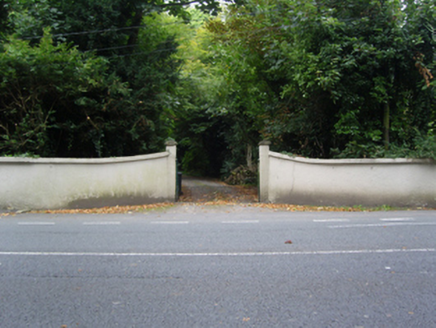
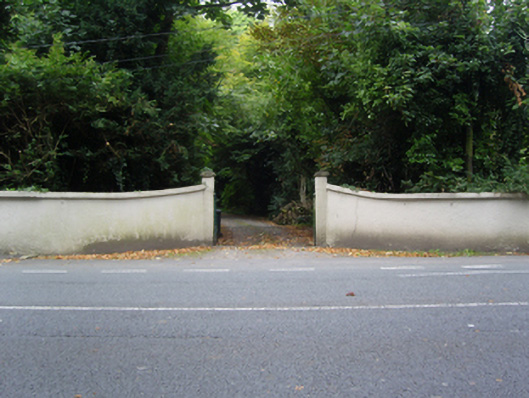
Detached three-bay (two-bay deep) two-storey country house, built 1803, on a T-shaped plan centred on single-bay single-storey flat-roofed advanced porch to ground floor; three-bay two-storey rear (north) elevation. Sold, 1872. "Improved", pre-1908, producing present composition. Occupied, 1911. Sold, 1932. For sale, 2014. Interior including (ground floor): vestibule retaining encaustic tiled floor; square-headed door opening into hall with carved timber Classical-style surround framing glazed timber panelled door having oversailing overlight; hall retaining carved timber Classical-style surrounds to door openings framing timber panelled doors, decorative plasterwork cornice to compartmentalised ceiling centred on "Acanthus"-detailed ceiling rose, staircase on a dog leg plan with cast-iron balusters supporting carved timber banister terminating in volute, carved timber Classical-style surrounds to door openings to landing framing timber panelled doors, and decorative plasterwork cornice to ceiling centred on "Acanthus"-detailed ceiling roses in decorative plasterwork frames; bow-ended drawing room (west) on an L-shaped plan retaining carved timber surround to door opening framing timber panelled door, cut-veined grey marble Classical-style chimneypiece, and picture railing below moulded plasterwork cornice to ceiling; bow-ended dining room (east) on an L-shaped plan retaining carved timber surround to door opening framing timber panelled door, cut-limestone Classical-style chimneypiece, and picture railing below moulded plasterwork cornice to ceiling; and carved timber surrounds to door openings to remainder framing timber panelled doors with carved timber surrounds to window openings framing timber panelled reveals or shutters on panelled risers. Set in landscaped grounds with chamfered piers to perimeter having cut-granite shallow pyramidal capping supporting spear head-detailed cast-iron double gates.
Appraisal
A country house erected for Sir William Stamer (1765-1838), one-time Lord Mayor of Dublin (fl. 1809-10; Irish Times 10th April 2014), representing an important component of the domestic built heritage of south County Dublin with the architectural value of the composition confirmed by such attributes as the deliberate alignment maximising on scenic vistas overlooking gently rolling grounds with a mountainous backdrop in the distance; the near-symmetrical footprint centred on a Classically-detailed porch; the diminishing in scale of the openings on each floor producing a graduated visual impression with the principal "apartments" defined by polygonal bows; and the balustraded roofline: meanwhile, aspects of the composition clearly illustrate the continued development or "improvement" of the country house in the later nineteenth century (Pearson 1998, 38). Having been reasonably well maintained, the elementary form and massing survive intact together with substantial quantities of the original fabric, both to the exterior and to the interior where encaustic tile work; contemporary joinery; Classical-style chimneypieces; and decorative plasterwork enrichments, all highlight the artistic potential of the composition. Furthermore, an adjacent coach house (extant 1908); and a nearby gate lodge (see 60260169), all continue to contribute positively to the group and setting values of a self-contained estate having historic connections with the Stamer family including Sir Lovelace Stamer (1794-1860; Lewis 1837 I, 392); and the Bookey family including Georgina Bookey (née Erskine) (d. 1908) and Georgina Eliza Bookey (d. 1933).