

Survey Data
Reg No
60230031
Rating
Regional
Categories of Special Interest
Architectural, Artistic, Historical, Social
Previous Name
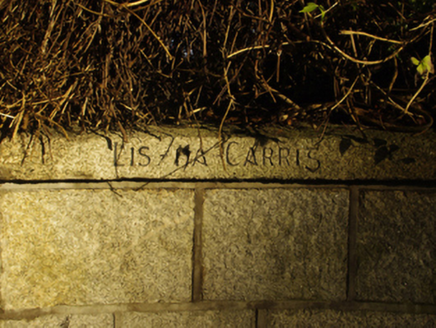
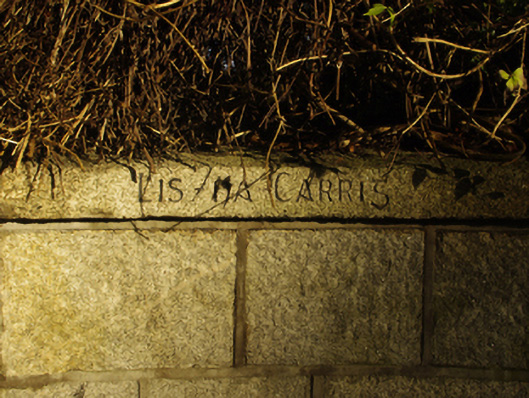
Lisnacarrig originally Mount Aventine
Original Use
House
In Use As
House
Date
1860 - 1865
Coordinates
321550, 225111
Date Recorded
20/11/2014
Date Updated
--/--/--
Description
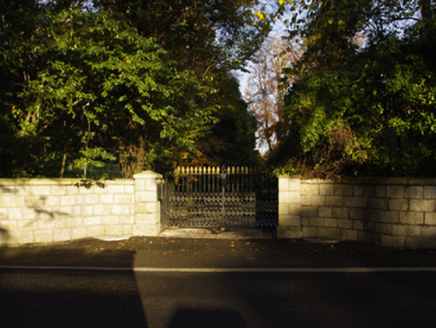
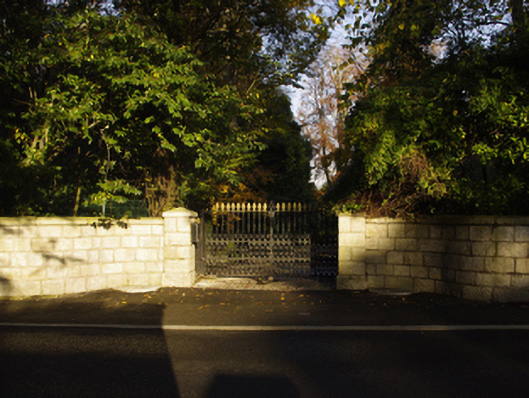
Detached three-bay (three-bay deep) two-storey house, built 1862, on a rectangular plan; three-bay two-storey rear (east) elevation. Extended, 1998; 2004, producing present composition. Hipped slate roof on a U-shaped plan with clay or terracotta ridge tiles, paired rendered central chimney stacks on rendered bases having curvilinear capping supporting yellow terracotta octagonal pots, and cast-iron rainwater goods on cut-granite cornice retaining cast-iron downpipes. Creeper-covered rendered, ruled and lined walls on cut-granite chamfered cushion course on rendered, ruled and lined plinth with rusticated cut-granite piers or pilasters to corners. Segmental-headed central door opening in square-headed recess approached by flight of four replacement bull nose-detailed cut-granite steps, timber doorcase with fluted pilasters on padstones supporting swan neck pediment on blind frieze on ogee-detailed stringcourse, and rendered surround with monolithic pilasters on padstones supporting ogee-detailed cornice on blind frieze framing timber panelled double doors having sidelights on panelled risers below fanlight. Square-headed flanking window opening in bipartite arrangement (north) with cut-granite sill, pilaster mullion, and moulded rendered lugged surround with ogee-detailed hood moulding on blind frieze framing one-over-one timber sash windows. Square-headed flanking window opening (south) with cut-granite sill, and moulded rendered lugged surround with ogee-detailed hood moulding on blind frieze framing one-over-one timber sash window. Camber-headed window openings (first floor) with cut-granite sills, and moulded rendered surrounds framing two-over-two timber sash windows. Set in landscaped grounds with repointed granite ashlar piers to perimeter having cut-granite shallow pyramidal capping supporting crocketed cast-iron double gates.
Appraisal
A house erected by John Bentley (1827-1906) representing an important component of the mid nineteenth-century domestic built heritage of south County Dublin with the architectural value of the composition, 'a very handsome villa with extensive out-offices [completed] after designs by Mr. Carson [Edward Henry Carson (1822-81)]' (The Dublin Builder 1st June 1862, 140), confirmed by such attributes as the compact near-square plan form centred on a Classically-detailed doorcase demonstrating good quality workmanship; and the diminishing in scale of the openings on each floor producing a graduated visual impression with the principal "apartments" defined by bipartite or polygonal bay windows. Having been well maintained, the form and massing survive intact together with substantial quantities of the original fabric, both to the exterior and to the interior where decorative plasterwork enrichments highlight the artistic potential of a house having historic connections Edward Albert Seale (1866-1943) '[of] Mount Aventine Foxrock' (The Dublin University Calendar 1895, 707); and Edmond McCartan-Mooney (1856-1933) 'of Lisnacarrig Foxrock' (The Irish Law Times 13th May 1933, 138). NOTE: Lis-na-Carraig was the home of the Right Honourable Sir Henry Augustus Robinson KCB (1857-1927), Vice-President of the Local Government Board for Ireland (appointed 1898; retired 1922), who, in "Memories Wise and Otherwise" (1923), describes arriving at the house during Easter Week 1916 to find his 'wife and daughter-in-law sitting on the steps listening to the booming of the big guns over Dublin' (Robinson 1923, 238). His son, Sir Christopher Henry Lynch-Robinson (1884-1958), author of "The Last of the Irish R.M.s" (1951), describes an episode during the Irish Civil War (1922-23) when 'sitting in [the large sitting-room-hall] one evening after dinner...two men burst into the hall and proceeded, without so much as by your leave, to open fire on us with revolvers. My father and I pulled out our automatics at once and fired back, whereupon the two men rushed past us and dived out onto the lawn through the two big windows, glass and all... I cannot explain why, but I can only record that nobody was hit, and that most of the shots went into the ceiling' (Lynch-Robinson 1951, 171). Sir Henry and his son were threatened with court martial 'for resisting the soldiers of the Irish Republic in the execution of their duty' and, acting on behalf of the pro-treaty forces, they were visited the next day by Michael Collins (1890-1922) who advised them that the Provisional Government was in no position to protect anyone and to 'clear out and come back later when things had settled down a bit'. Sir Henry ultimately sold Lis-na-Carrig and retired to Ealing.