Survey Data
Reg No
41401829
Rating
Regional
Categories of Special Interest
Architectural, Social
Previous Name
Unshena National School
Original Use
School
Date
1850 - 1855
Coordinates
263591, 321555
Date Recorded
29/04/2012
Date Updated
--/--/--
Description
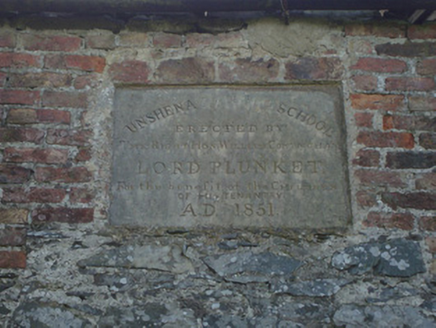
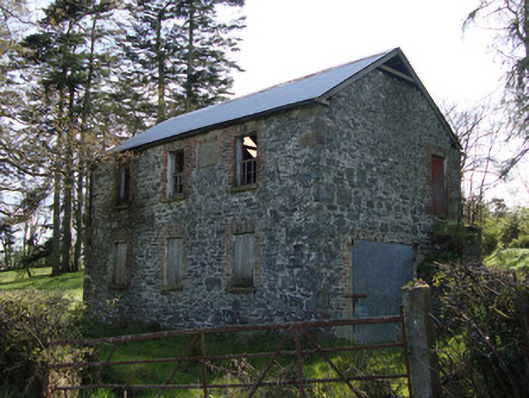
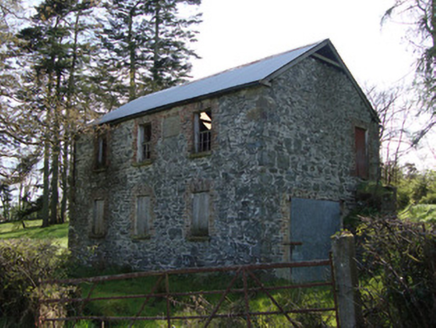
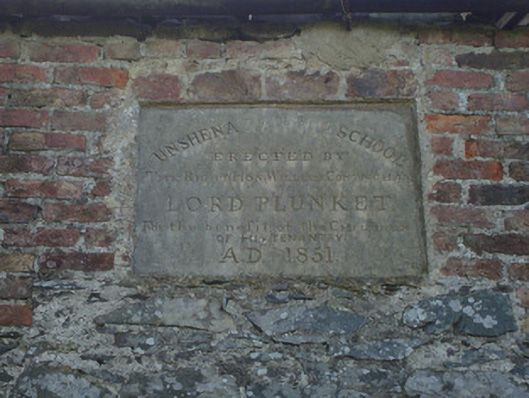
Detached three-bay two-storey former school, dated 1851, having external stone steps leading to first floor of north gable end. Now vacant. Pitched roof with replacement corrugated-metal sheeting, with cast-iron gutter brackets. Coursed rubble stone walls, with tooled cut-stone quoins, having carved stone date plaque to centre of east, roadside, elevation. Square-headed window openings with timber casement windows throughout, having brick block-and-start surrounds and stone sills, and with remains of six-over-six pane timber sliding sash windows to east and west elevations. Two bays of windows to rear (west) elevation. External steps have red brick quoins and simple wrought-iron handrail, approaching square-headed timber battened door, having red brick block-and-start surround. Square-headed recent door opening to ground floor of north elevation, having recent steel door. Located to west of rural country road to north-west of Rockcorry.
Appraisal
Opened in 1851, Unshinagh National School was patronized by William Conyngham, Lord Plunket, for the children of his tenants. The Plunkets had an estate in the Rockcorry area to the south-east, as well as large tracts of land in Mayo, Galway, Louth, Roscommon and Monaghan. This simple building is of social and architectural significance to the area. It may have had incorporated a schoolmaster's residence. The original form and character of the mid-nineteenth-century school are still evident, the plaque eloquently explaining its function. The contrast between rubble walling, some cut-stone quoins, and red brick details, add interest. In its former context as a school, it provides social and historical focus in the local rural area, while the form and fabric of the present structure, although disused, are an attractive and pleasing part of the local architectural heritage corpus.