Survey Data
Reg No
41400403
Rating
Regional
Categories of Special Interest
Architectural, Social
Original Use
House
Historical Use
Shop/retail outlet
Date
1840 - 1860
Coordinates
270455, 346720
Date Recorded
28/03/2012
Date Updated
--/--/--
Description
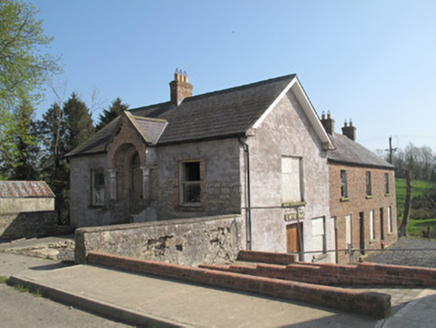
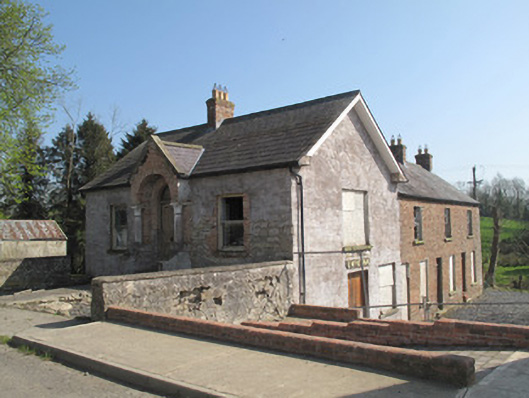
Attached three-bay split-level house, built c.1850, with gabled entrance bay. Currently unoccupied (March 2012) no longer in use. Pitched slate roof with red brick chimneystack in facer bond, and clay chimneypots. Replacement rainwater goods and clay ridge tiles. Render coping to porch. Coursed squared rubble limestone walls, recently partially re-rendered. Square-headed window openings having red brick surrounds, stone sills and timber sliding sash windows, one-over-one pane to front (north-west) and rear (south-east) elevations, two-over-two at first floor level, and six-over-six pane with steel railings at ground floor level to north-east elevation. Openings to south-west gable blocked. Porch comprises brick pediment supported on Doric-style render columns having tooled limestone bases on rendered plinth walls, with round-headed doorway having gauged red brick surround, timber panelled door and boarded fanlight, approached by two nosed limestone steps and concrete pathway. Square-headed door opening at ground floor level to south-west gable with double-leaf timber panelled door, having timber fascia over with 'O'McKENNA’ in raised lettering. Terrace of houses adjoining rear elevation.
Appraisal
This simple and aesthetically-pleasing building, formerly known as 'Curleys' forms part of the Mullan mill complex, and was built to accommodate the owner of the flax mill in the late eighteenth century. It also housed the Post Office and shop and may even have been a licensed premises, thus serving a number of important village functions. Its façade has strong symmetry, and the fascia to the side elevation adds contextual interest. Mullan is representative of the numerous mill villages which were constructed in Ulster throughout the eighteenth and nineteenth centuries.