Survey Data
Reg No
31310101
Rating
Regional
Categories of Special Interest
Architectural, Artistic, Historical, Social
Original Use
Farm house
In Use As
Farm house
Date
1861 - 1873
Coordinates
127186, 276212
Date Recorded
07/12/2010
Date Updated
--/--/--
Description
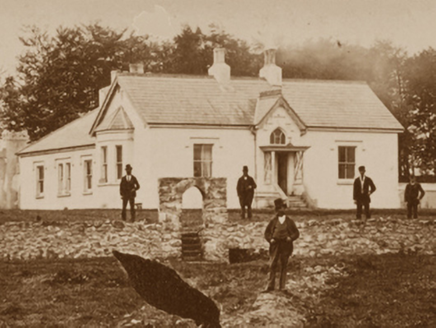
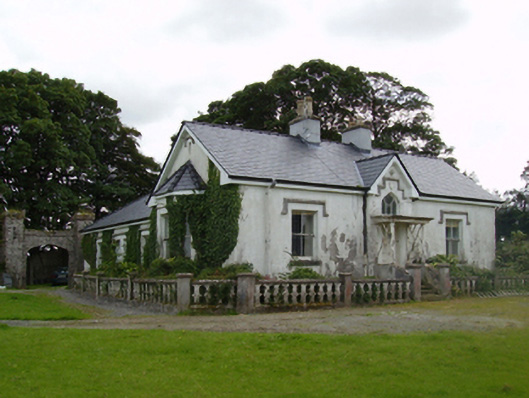
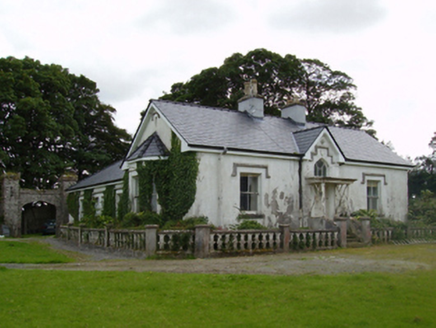
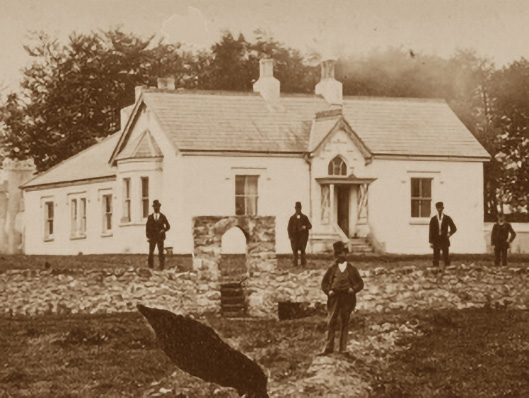
Detached three-bay single-storey farmhouse, extant 1873, on a T-shaped plan centred on single-bay single-storey gabled "bas-relief" breakfront with single-bay (three-bay deep) single-storey central return (south). Sold, 1897. Occupied, 1911. Reroofed. Replacement pitched slate roof on a T-shaped plan centred on pitched (gabled) slate roof with hipped slate roof (south), ridge tiles, paired cement rendered central chimney stacks having chamfered capping supporting yellow terracotta octagonal or tapered pots, and uPVC rainwater goods on box eaves. Creeper- or ivy-covered rendered walls. Bisected Tudor-headed central door opening approached by flight of five steps, concealed dressings with crow stepped hood moulding over framing timber panelled door having overlight. Square-headed window openings with cut-limestone sills, and concealed dressings having chamfered reveals with hood mouldings over framing two-over-two timber sash windows. Interior including central entrance hall retaining carved timber surrounds to door openings framing timber panelled doors; and carved timber surrounds to door openings to remainder framing timber panelled doors with timber panelled shutters to window openings. Set in unkempt landscaped grounds including "haha".
Appraisal
A farmhouse representing an integral component of the later nineteenth-century domestic built heritage of the rural environs of Claremorris with the architectural value of the composition, one rooted firmly in the contemporary "picturesque" fashion, confirmed by such attributes as the deliberate alignment maximising on scenic vistas overlooking landscaped grounds; the symmetrical footprint centred on a "pointed" doorcase showing a stylised overlight; and the definition of the principal "apartments" by handsome bay windows. Having been reasonably well maintained, the elementary form and massing survive intact together with substantial quantities of the original fabric, both to the exterior and to the interior, thus upholding the character or integrity of the composition. Furthermore, adjacent outbuildings (extant 1894) continue to contribute positively to the group and setting values of a self-contained ensemble having historic connections with the Tighe family including John Edward Tighe (NUIG); and the Stephens family including Thomas Stephens (b. 1874), 'Farmer' (NA 1911).