Survey Data
Reg No
31309201
Rating
Regional
Categories of Special Interest
Architectural, Artistic, Historical, Social
Original Use
Farm house
In Use As
Farm house
Date
1800 - 1805
Coordinates
138035, 281495
Date Recorded
23/11/2010
Date Updated
--/--/--
Description
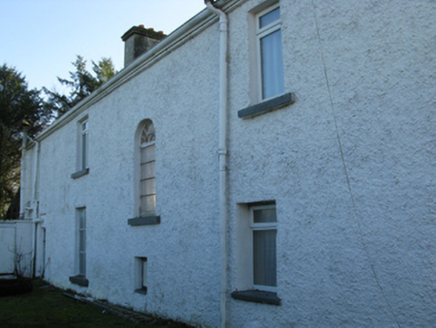
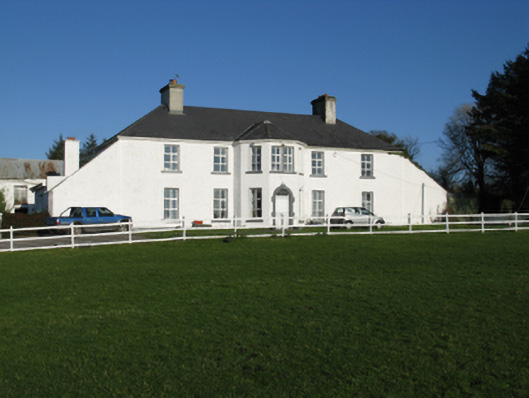
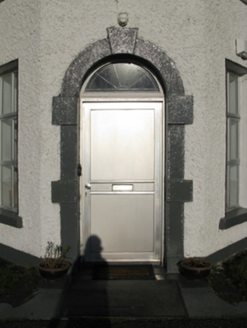
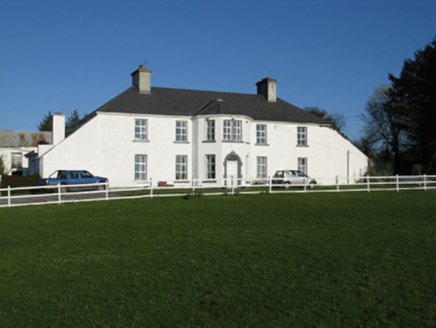
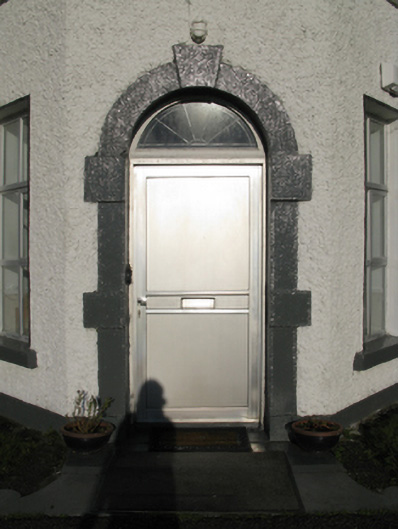
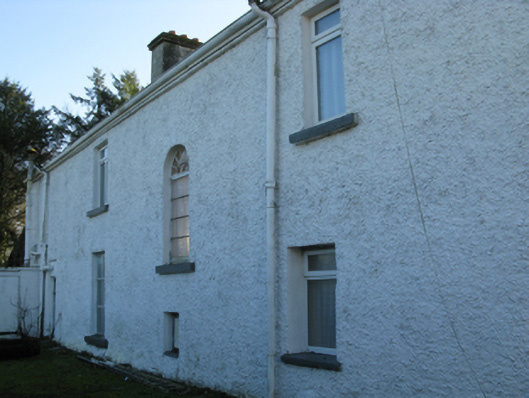
Detached five-bay two-storey farmhouse, built 1801[?]; extant 1838, on a T-shaped plan centred on single-bay full-height breakfront on an engaged half-octagonal plan; three-bay two-storey rear (north) elevation. For sale, 1854[?]. Occupied, 1911. Sold, 1914. Extensively renovated. Replacement hipped artificial slate roof on a T-shaped plan centred on half-octagonal artificial slate roof with clay ridge tiles, cement rendered chimney stacks having corbelled stepped capping supporting terracotta pots, and uPVC rainwater goods on timber eaves boards on rendered cut-limestone eaves retaining some cast-iron downpipes. Roughcast walls bellcast over rendered plinth. Segmental-headed central door opening with drag edged dragged cut-limestone block-and-start surround centred on keystone framing replacement aluminium panelled door having overlight. Square-headed window openings centred on square-headed window opening in bipartite arrangement (first floor) with square-headed window openings to rear (north) elevation centred on round-headed window opening (half-landing), drag edged dragged cut-limestone sills, and concealed dressings framing replacement aluminium casement windows with replacement uPVC casement windows to rear (north) elevation centred on fixed-pane timber fitting having fanlight. Set in landscaped grounds.
Appraisal
A farmhouse erected (1801) for Peter Rutledge (c.1742-1805; Ruttledge 1988, 433) in the shadow of the medieval Ballyhowly Castle (extant 1627; in ruins 1838) representing an important component of the domestic built heritage of the outskirts of Knock with the architectural value of the composition, one recalling the contemporary Hazelrock Lodge (extant 1838), near Killavally (see 31308903), confirmed by such attributes as the compact rectilinear plan form centred on a polygonal breakfront; and the slight diminishing in scale of the openings on each floor producing a feint graduated visual effect. However, while the elementary form and massing survive intact, the introduction of replacement fittings to the openings has not had a beneficial impact on the external expression or integrity of the composition. Nevertheless, an adjoining walled garden (extant 1838) continues to contribute positively to the group and setting values of a self-contained ensemble having historic connections with the Ruttledge family including Thomas Ruttledge (1778-1829); William Ruttledge (1812-1904; NA 1901); and Thomas Ormsby Ruttledge (1871-1953; NA 1911).