Survey Data
Reg No
31309104
Rating
Regional
Categories of Special Interest
Architectural, Artistic, Historical, Social
Original Use
Farm house
In Use As
Farm house
Date
1800 - 1838
Coordinates
130251, 279788
Date Recorded
09/12/2010
Date Updated
--/--/--
Description
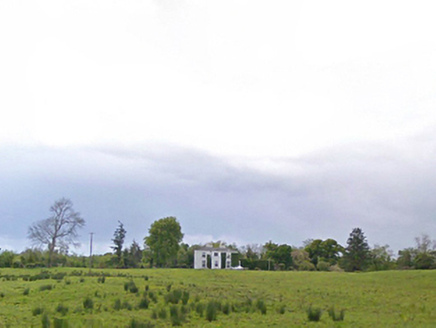
Detached three-bay two-storey farmhouse, extant 1838, on an L-shaped plan centred on single-bay full-height breakfront with single-bay single-storey flat-roofed projecting porch to ground floor; single-bay (west) or three-bay (east) two-storey side elevations. "Improved", pre-1894, producing present composition. Occupied, 1911. Renovated. Replacement hipped fibre-cement slate roof on an L-shaped plan with clay ridge tiles, paired rendered "wallhead" chimney stacks to rear (north) elevation having stringcourses below capping supporting elongated terracotta or yellow terracotta octagonal pots, and uPVC rainwater goods on timber boxed cut-limestone eaves[?]. Part creeper- or ivy-covered rendered walls. Square-headed window openings centred on square-headed window opening in camber-headed recess (ground floor) with cut-limestone sills, and concealed dressings framing four-over-four timber sash (ground floor) or replacement uPVC casement (first floor) windows. Set in landscaped grounds with limestone ashlar piers to perimeter having monolithic stringcourses below pyramidal capping.
Appraisal
A farmhouse representing an integral component of the domestic built heritage of the rural environs of Claremorris with the architectural value of the composition confirmed by such attributes as the deliberate alignment maximising on scenic vistas overlooking gently rolling grounds; the compact plan form centred on an expressed, albeit later porch; and the slight diminishing in scale of the openings on each floor producing a feint graduated visual impression: meanwhile, a comparison of the first (surveyed 1838; published 1839) and second (surveyed 1894; published 1896) editions of the Ordnance Survey illustrates the continued development or "improvement" of the farmhouse in the later nineteenth century. Having been well maintained, the elementary form and massing survive intact together with quantities of the original fabric, both to the exterior and to the interior where contemporary joinery; and restrained chimneypieces, all highlight the artistic potential of the composition (Ruane 1996 II, M15): the localised introduction of replacement fittings to the openings, however, has not had a beneficial impact on the character or integrity of the farmhouse. Furthermore, adjacent outbuildings (extant 1838) continue to contribute positively to the group and setting values of a self-contained ensemble having historic connections with the Begley family including William Begley (1859-1931), 'Farmer' (NA 1911).