Survey Data
Reg No
31309012
Rating
Regional
Categories of Special Interest
Architectural, Historical, Social
Original Use
Farm house
Date
1812 - 1838
Coordinates
126435, 285118
Date Recorded
17/01/2011
Date Updated
--/--/--
Description
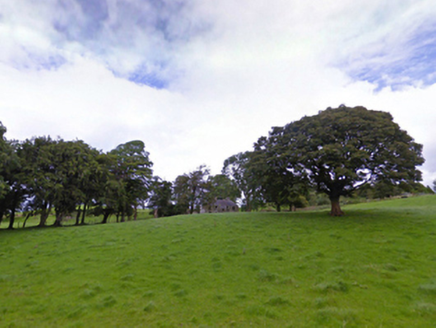
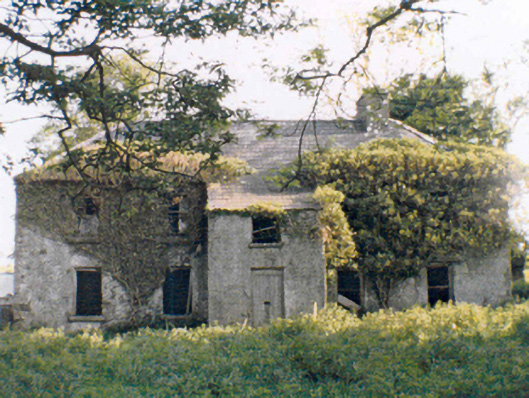
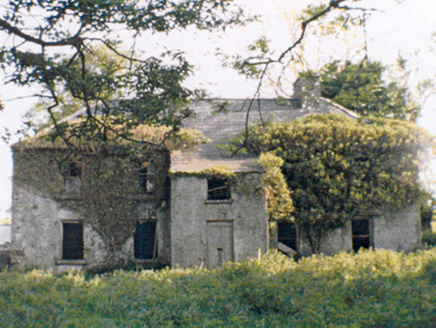
Detached three-bay two-storey farmhouse, extant 1838, on a T-shaped plan centred on single-bay two-storey lean-to projecting breakfront. Occupied, 1901. Vacant, 1911. Now disused. Hipped slate roof on a T-shaped plan centred on lean-to slate roof with clay or terracotta ridge tiles, rendered chimney stacks having corbelled stepped stringcourses below capping, and no rainwater goods surviving on roughcast cut-limestone eaves retaining cast-iron downpipes. Part creeper- or ivy-covered roughcast battered walls. Square-headed central door opening with concealed dressings framing remains of timber boarded or tongue-and-groove timber panelled door. Square-headed window openings to "cheeks" with lichen-spotted cut-limestone sills, and concealed dressings framing remains of timber fittings. Square-headed window openings with lichen-spotted cut-limestone sills, and concealed dressings framing remains of one-over-one timber sash windows. Interior including (ground floor): central hall retaining timber surrounds to door openings framing timber panelled doors; and timber surrounds to some door openings to remainder framing timber panelled doors with timber surrounds to some window openings framing timber panelled reveals or shutters. Set in unkempt grounds with limestone ashlar piers to perimeter having lichen-covered capping supporting flat iron "farm gate".
Appraisal
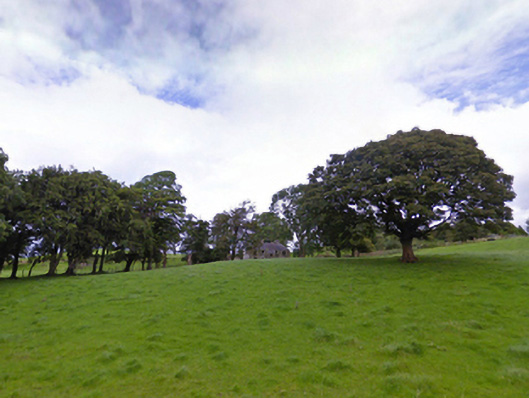
A dilapidated farmhouse representing an integral component of the early nineteenth-century domestic built heritage of the outskirts of Balla with the architectural value of the composition, one erected on a site leased from the Lynch Blosse estate, suggested by such attributes as the deliberate alignment maximising on scenic vistas overlooking rolling grounds; the compact plan form centred on an expressed breakfront; and the slight diminishing in scale of the openings on each floor producing a feint graduated visual impression. A prolonged period of neglect notwithstanding, the elementary form and massing survive intact together with quantities of the original fabric, both to the exterior and to the interior, thus upholding much of the character of the composition. Furthermore, adjacent outbuildings (extant 1894) continue to contribute positively to the group and setting values of a self-contained ensemble having historic connections with the Nally family including William Nally (d. 1899), 'late of Rockstown Balla County Mayo' (Calendars of Wills and Administrations 1906, 389); Patrick William Nally (1856-91), a member of the Supreme Council of the Irish Republican Brotherhood (IRB) imprisoned in Mountjoy Jail for his alleged role as a leader of the so-called "Crossmolina Conspiracy" (1881; cf. 31309018); and Jeremiah Edward Nally (1864-1908), 'Surgeon Physician [and] County Coroner' (NA 1901; Calendars of Wills and Administrations 1908, 429): the site remains of some additional interest as the venue of the National Athletic Sports of Mayo (1879-80), an anti-Establishment meeting considered a precursor to the Gaelic Athletics Association (GAA).