Survey Data
Reg No
31302203
Rating
Regional
Categories of Special Interest
Architectural, Artistic, Historical, Social
Original Use
Farm house
Date
1700 - 1838
Coordinates
118665, 326511
Date Recorded
17/02/2012
Date Updated
--/--/--
Description
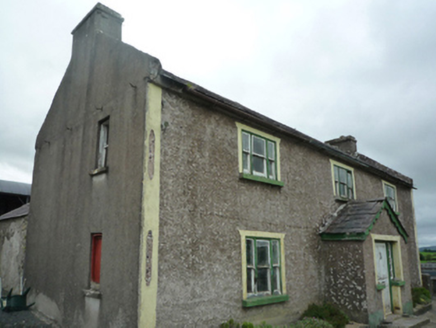
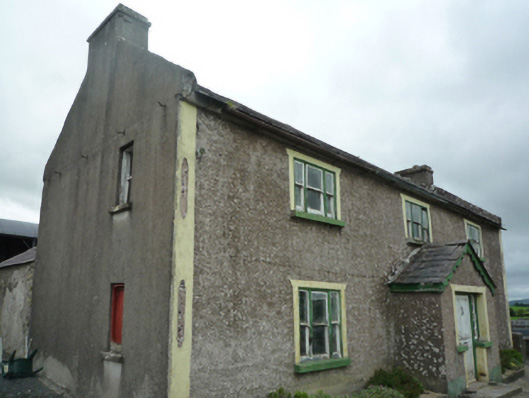
Detached three-bay two-storey farmhouse, extant 1838, on a T-shaped plan centred on single-bay single-storey gabled projecting porch to ground floor. "Improved", pre-1896, producing present composition. Occupied, 1911. Occupied, 1995. Vacant, 2000. Now disused. Pitched slate roofs on timber construction including pitched (gabled) slate roof (porch) with remains of clay ridge tiles, rendered coping to gables with rendered chimney stacks to apexes having stepped capping supporting terracotta pots, decorative timber bargeboards to gable (porch), and remains of cast-iron rainwater goods on rendered cut-limestone eaves. Roughcast wall to front (east) elevation on rendered plinth with ceramic- or glass-encrusted gritdashed roughcast-panelled rendered strips to ends; rendered surface finish (remainder). Hipped square-headed central door opening with timber mullions on step threshold, and rendered "lugged" surround framing timber panelled door having sidelights. Square-headed window openings in tripartite arrangement with concrete sills, timber mullions, and rendered "lugged" surrounds framing one-over-one timber sash windows having one-over-one sidelights. Set in landscaped grounds.
Appraisal
A farmhouse representing an integral component of the domestic built heritage of the rural environs of Killala with the architectural value of the composition suggested by such traits as the deliberate skewed alignment maximising on scenic vistas overlooking gently rolling grounds; the compact symmetrical footprint centred on an expressed, albeit later porch; and the somewhat disproportionate bias of solid to void in the massing compounded by the slight diminishing in scale of the centralised openings on each floor producing a graduated visual impression with those openings showing elegant tripartite glazing patterns. A prolonged period of unoccupancy notwithstanding, the elementary form and massing survive intact together with substantial quantities of the original fabric, thereby upholding much of the character or integrity of a farmhouse having historic connections with the Rogers family including Henry Rogers (Slater 1846, 129); and the Wood family including James Wood (d. 1884), 'Farmer late of Foxburrow [sic] County Mayo' (Calendars of Wills and Administrations 1884, 845).