Survey Data
Reg No
15704027
Rating
Regional
Categories of Special Interest
Archaeological, Architectural, Artistic, Historical, Social
Original Use
Country house
In Use As
Country house
Date
1865 - 1870
Coordinates
284139, 118328
Date Recorded
21/01/2008
Date Updated
--/--/--
Description
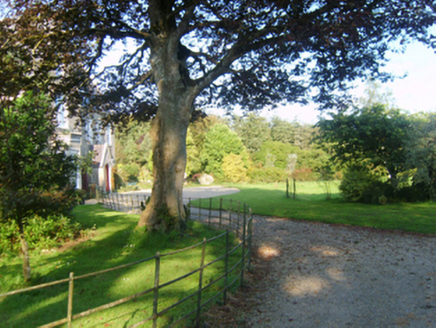
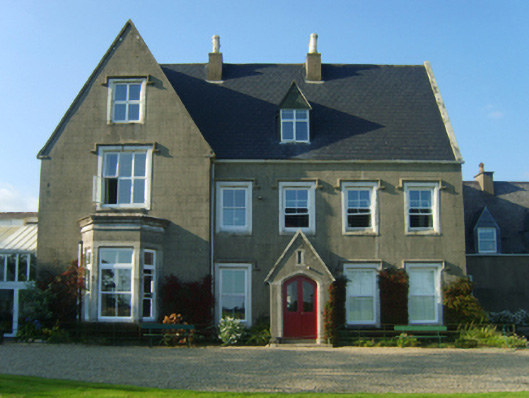
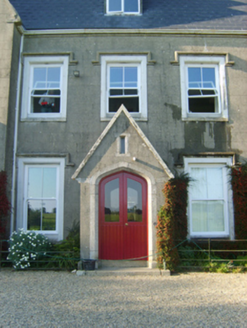
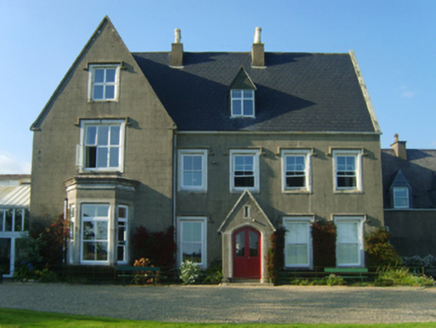
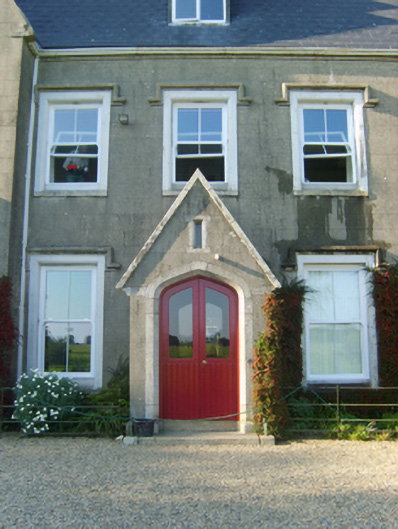
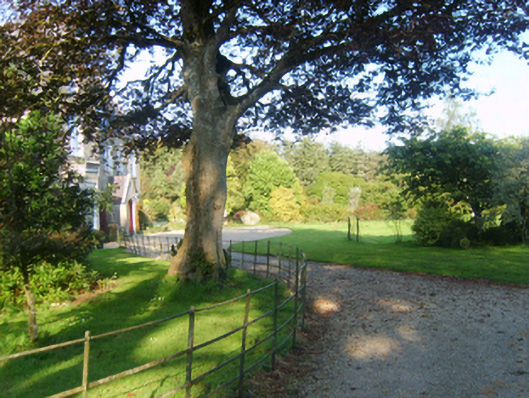
Detached three-bay two-storey country house with dormer attic, reconstructed 1867, on an N-shaped plan off-centred on single-bay single-storey gabled projecting porch to ground floor with single-bay full-height gabled advanced end bay; single-bay (single-bay deep) full-height return (north). Occupied, 1911. Renovated, ----. Replacement pitched artificial slate roof on an N-shaped plan; pitched (gabled) slate roof (porch), ridge tiles, paired rendered central chimney stacks having cut-granite capping supporting yellow terracotta octagonal pots, lichen-covered cut-granite coping to gables including lichen-covered cut-granite coping to gable (porch) on cut-granite "Cavetto" kneelers, rooflights (north), and cast-iron rainwater goods on cut-granite eaves retaining some cast-iron hoppers and downpipes. Part creeper- or ivy-covered rendered, ruled and lined battered walls; roughcast battered surface finish (north) on slate hung base. Tudor-headed off-central door opening with cut-granite step supporting cast-iron bootscrapers, and cut-granite surround having chamfered reveals framing glazed timber boarded or tongue-and-groove timber panelled double doors. Tudor-headed door opening into country house with glazed timber boarded or tongue-and-groove timber panelled door. Square-headed window openings with cut-granite sills, and rendered "bas-relief" surrounds having chamfered reveals with hood mouldings over framing replacement two-over-two sash windows having part exposed sash boxes. Square-headed window openings (north) with cut-granite sills, and concealed dressings framing replacement uPVC casement windows. Set in landscaped grounds.
Appraisal
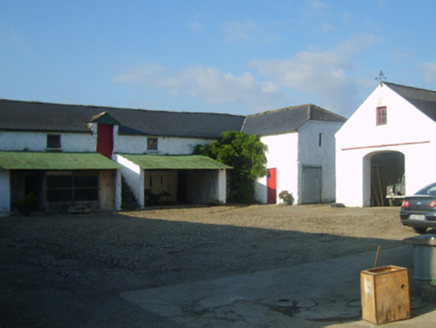
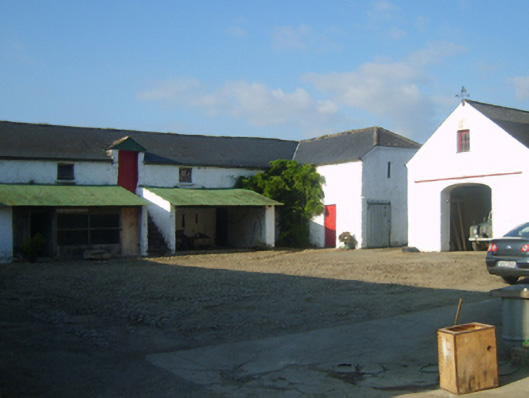
A country house reconstructed for Joseph William Deane (1815-1908) representing an important component of the domestic built heritage of south County Wexford with the architectural value of the composition, one transforming an eighteenth-century Georgian house (1770) annotated as "Long-graig [of] Sutton Esquire" by Taylor and Skinner (1778, p.149), confirmed by such attributes as the deliberate alignment maximising on scenic vistas overlooking gently rolling grounds; the compact, albeit multi-faceted plan form off-centred on an expressed porch; the slight diminishing in scale of the openings on each floor producing a graduated visual impression with the principal "apartment" or reception room defined by a polygonal bay window; and the miniature gablets embellishing a high pitched roofline: meanwhile, aspects of the composition, in particular stout wall masses displaying a battered silhouette, confirm the archaeological potential of a country house '[dating] to the early seventeenth century when associated with the Bryan family but remains probably earlier' [SMR WX040-012----]. Having been well maintained, the elementary form and massing survive intact together with quantities of the original or replicated fabric, both to the exterior and to the interior, including a partial slate hung surface finish widely regarded as an increasingly endangered hallmark of the architectural heritage of County Wexford: meanwhile, contemporary joinery; chimneypieces; and plasterwork refinements, all highlight the artistic potential of the composition. Furthermore, adjacent outbuildings (extant 1840); a walled garden (1840); and a "picturesque" gate lodge (see 15704028), all continue to contribute positively to the group and setting values of an estate having historic connections with Caesar Sutton (d. 1839) and 'the scene of a sharp action during the disturbances of 1798 between the insurgents and the forces under General John Moore [1761-1809] who had taken position in the demesne in order to intercept their retreat from Vinegar Hill by way of Clonmines' (Lewis 1837 I, 364).