Survey Data
Reg No
15703918
Rating
Regional
Categories of Special Interest
Architectural, Artistic, Historical, Social
Previous Name
Fruit Hill House
Original Use
Farm house
In Use As
Farm house
Date
1745 - 1750
Coordinates
270290, 116951
Date Recorded
07/09/2007
Date Updated
--/--/--
Description
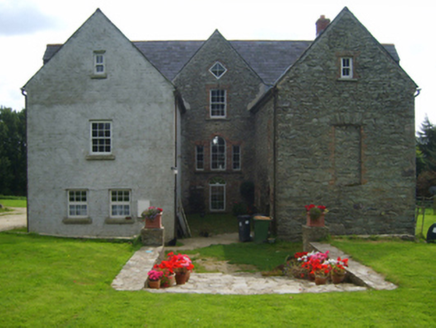
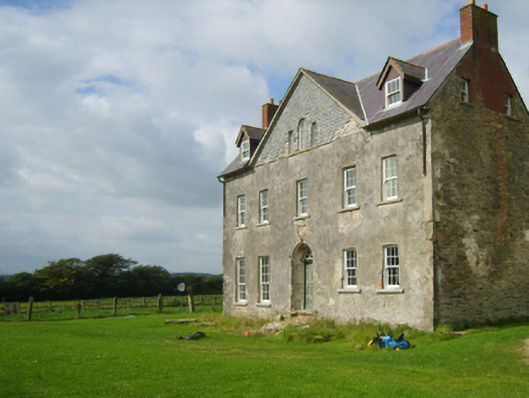
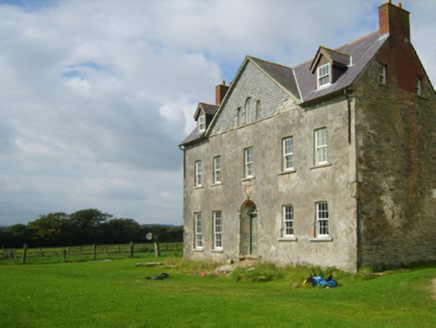
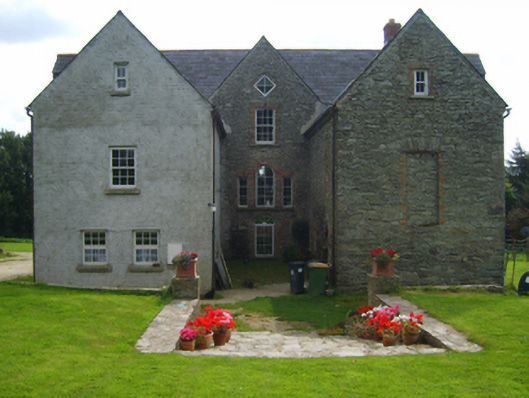
Detached five-bay two-storey farmhouse with dormer attic, built 1746; extant 1755, on a U-shaped plan with pair of single-bay (three-bay deep) full-height returns (north) centred on single-bay (single-bay deep) full-height central return. Occupied, 1911. Vacated, 1934. In ruins, 1940. Sold, 1965. Resold, 2000. Undergoing "restoration", 2007. Replacement pitched slate roof on a U-shaped plan including gablets to window openings to dormer attic centred on pitched (gabled) slate roof, terracotta ridge tiles, repointed red brick Running bond chimney stacks having concrete capping supporting terracotta pots, and cast-iron rainwater goods on slate flagged eaves retaining abbreviated cast-iron downpipes. Lime rendered battered wall to front (south) elevation with slate hung surface finish (gable); part repointed coursed rubble stone battered walls (remainder) originally lime rendered with rough hewn rubble stone flush quoins to corners. Segmental-headed central door opening with steps now missing, and concealed red brick block-and-start surround having concave reveals framing timber panelled door having fanlight. Square-headed window openings with cut-granite sills, and concealed red brick block-and-start surrounds framing replacement six-over-six timber sash windows. "Venetian Window" to rear (north) elevation with cut-granite sill, and red brick block-and-start surround framing fixed-pane fitting having fixed-pane sidelights. Square-headed window opening (top floor) with cut-granite sill, and red brick block-and-start surround framing six-over-six timber sash window. Set in relandscaped grounds.
Appraisal
A farmhouse erected by George Glascott (d. 1755) representing an important component of the eighteenth-century domestic built heritage of south County Wexford with the architectural value of the composition, '[a] house of [the] Cromwellian type' (Hickey alias Doyle 1868, 185), confirmed by such attributes as the deliberate alignment maximising on scenic vistas overlooking gently rolling grounds; the symmetrical footprint centred on a restrained doorcase showing a simple radial fanlight; the uniform or near-uniform proportions of the openings on each floor; and the streamlined "Venetian Window" embellishing a high pitched roofline. Having been successfuly "restored" following a prolonged period of unoccupancy in the later twentieth century, the elementary form and massing survive intact together with quantities of the original or sympathetically replicated fabric, including a partial slate hung surface finish, thereby upholding much of the character or integrity of a farmhouse having historic connections with the Glascott family including George Glascott (d. 1838; Burke 1871 I, 509); Gerald Annesley Glascott (d. 1909; NA 1901); and John Glascott (d. 1938).