Survey Data
Reg No
15701917
Rating
Regional
Categories of Special Interest
Architectural, Historical, Social
Original Use
Farm house
Date
1700 - 1806
Coordinates
293102, 141250
Date Recorded
22/08/2007
Date Updated
--/--/--
Description
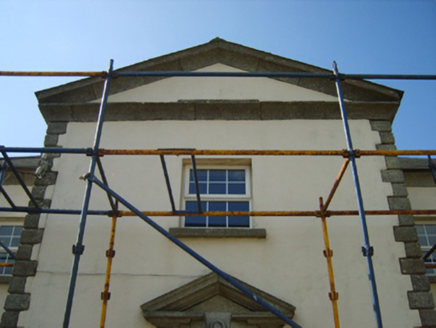
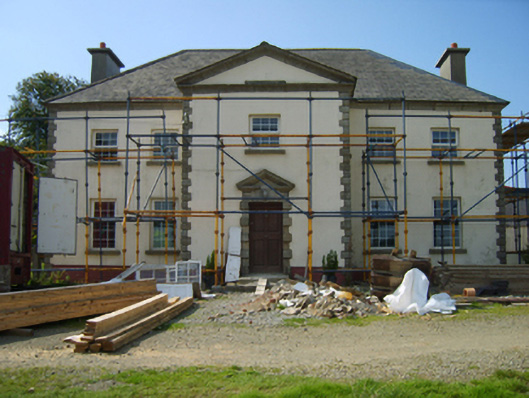
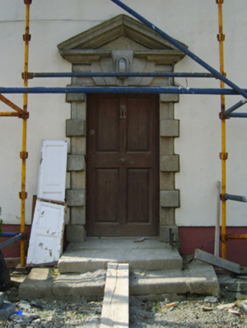
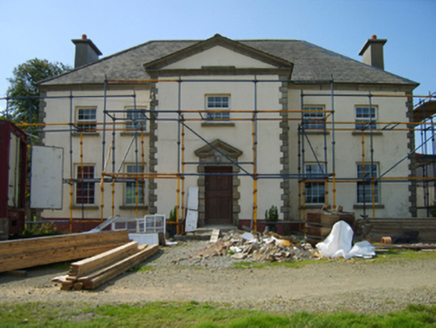
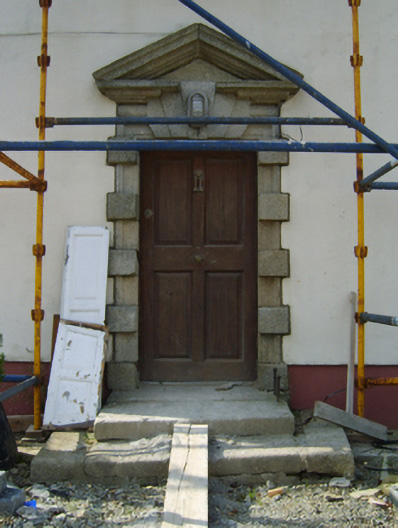
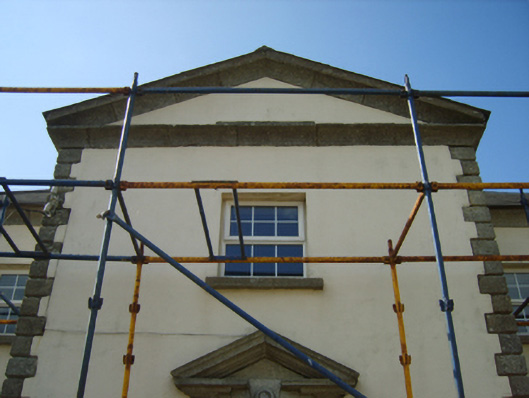
Detached three- or five-bay two-storey farmhouse, extant 1806, on a T-shaped plan centred on single-bay two-storey pedimented projecting breakfront; two-bay two-storey side elevations. Sold, 1885. Vacant, 1901. Occupied, 1911. Renovated, ----. Undergoing restoration, 2007. Replacement hipped artificial slate roof on a T-shaped plan centred on pitched (gabled) artificial slate roof, clay ridge tiles, cement rendered chimney stacks having concrete capping supporting ribbed terracotta tapered pots, and no rainwater goods surviving on cut-granite "Cavetto" cornice. Replacement cement rendered walls bellcast over rendered plinth with rusticated cut-granite quoins to corners including rusticated cut-granite quoins to corners (breakfront) supporting cut-granite "Cavetto" cornice. Square-headed central door opening with two cut-granite steps supporting cast-iron bootscrapers, cut-granite block-and-start surround with "Cyma Recta"- or "Cyma Reversa"-detailed pediment on pulvinated frieze framing replacement timber panelled door. Square-headed window openings with cut-granite sills, and concealed dressings framing replacement uPVC casement windows replacing eight-over-eight (ground floor) or three-over-three (first floor) timber sash windows. Interior undergoing reconstruction, 2007. Set in unkempt landscaped grounds.
Appraisal
A farmhouse representing an important component of the eighteenth-century domestic built heritage of County Wexford with the architectural value of the composition, '[the] seat [of] Arch. [Archibald] Ormston' (Sleater 1806, 89), confirmed by such attributes as the deliberate alignment maximising on scenic vistas overlooking gently rolling grounds; the symmetrical footprint centred on a Classically-detailed breakfront with a Monart-esque doorcase demonstrating good quality workmanship in a silver-grey granite (see 15701931); the diminishing in scale of the openings on each floor producing a graduated visual impression; and the pedimented roofline. Having been reasonably well maintained, the elementary form and massing survive intact together with quantities of the original fabric: however, an unfinished restoration may determine the ongoing architectural heritage status of a farmhouse having historic connections with the Browne family including Patrick Browne (d. 1918), 'Farmer and Merchant [late of] Broomlands Monart Enniscorthy County Wexford' (Calendars of Wills and Administrations 1918, n.p.).