Survey Data
Reg No
15700737
Rating
Regional
Categories of Special Interest
Architectural, Artistic, Historical, Social
Original Use
House
In Use As
House
Date
1930 - 1935
Coordinates
321469, 160158
Date Recorded
03/10/2007
Date Updated
--/--/--
Description
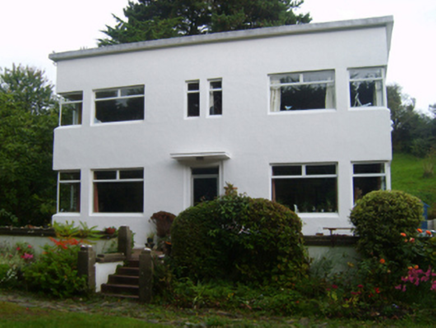
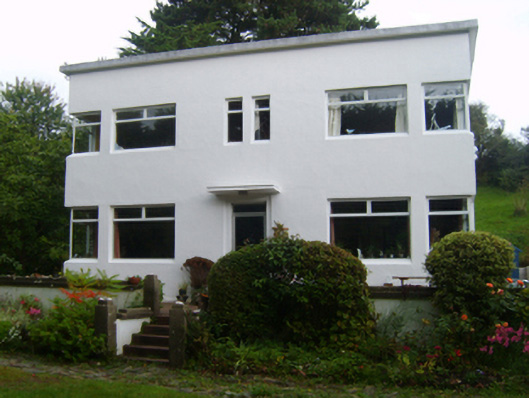
Detached three-bay (two-bay deep) two-storey flat-roofed seaside villa, built 1933, on a square plan with three-bay two-storey rear (north) elevation. Refenestrated, ----. Bitumen felt-covered flat roof behind parapet with rendered chimney stacks having concrete capping supporting louvered terracotta or yellow terracotta pots, and concealed rainwater goods retaining cast-iron octagonal or ogee hoppers and downpipes. Rendered walls on rendered plinth with bitumen felt-covered concrete coping to parapet. Square-headed central door opening in square-headed "bas-relief" recess with concrete step threshold, and concealed dressings with cantilevered canopy framing replacement glazed aluminium door having overlight. Square-headed window openings including square-headed corner window openings centred on paired square-headed window openings (first floor), concealed dressings including reinforced concrete lintels framing replacement aluminium casement windows replacing steel casement windows having horizontal glazing bars. Set in landscaped grounds with roughcast piers to perimeter having stepped capping supporting timber gates.
Appraisal
A seaside villa erected for Dr. William Cooke, Medical Officer at Mountjoy Prison, Dublin, representing an important component of the twentieth-century domestic built heritage of north County Wexford with the architectural value of the composition, one cited as being 'built by an architect of the same name' (Rudd 1994, 51-3) but latterly attributed to Samuel Dean of Higginbotham and Stafford (formed 1921) of Dublin, confirmed by such attributes as the compact "Cubic" plan form centred on a canopied doorcase; the slight diminishing in scale of the openings on each floor producing a graduated visual impression with those openings originally showing characteristic horizontal glazing patterns; and the parapeted roof doubling as a sun deck. Having been well maintained, the elementary form and massing survive intact together with substantial quantities of the original fabric, both to the exterior and to the timber boarded interior: however, the introduction of replacement fittings to the openings has not had a beneficial impact on the character or integrity of a seaside villa making a pleasing visual statement in a sylvan street scene.