Survey Data
Reg No
13401436
Rating
Regional
Categories of Special Interest
Artistic, Technical
Original Use
Gates/railings/walls
In Use As
Gates/railings/walls
Date
1780 - 1800
Coordinates
221644, 275051
Date Recorded
18/07/2005
Date Updated
--/--/--
Description
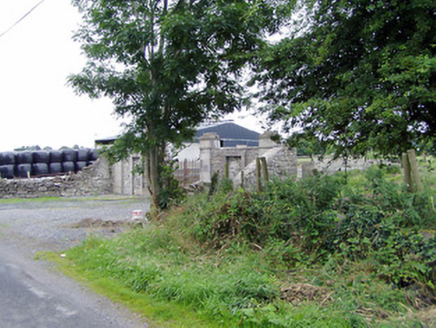
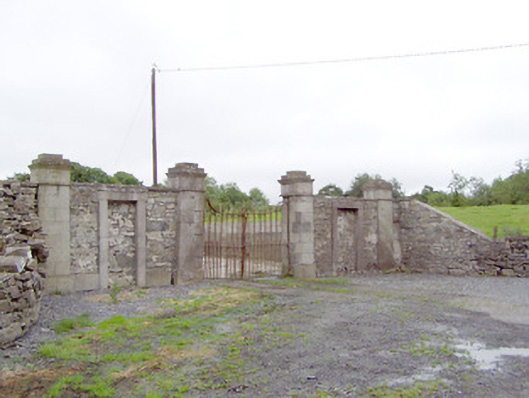
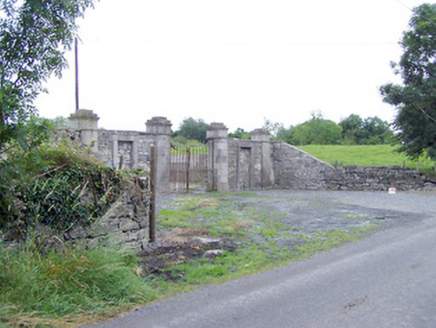
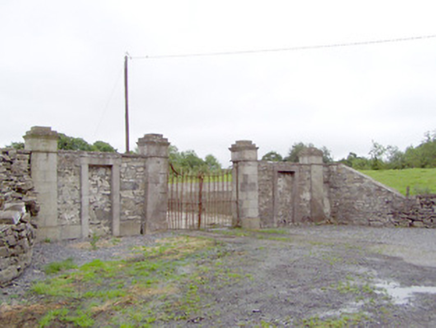
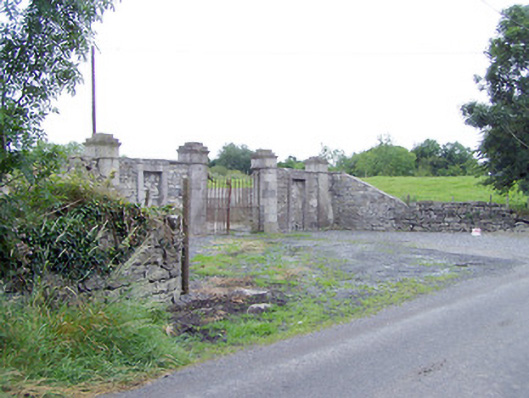
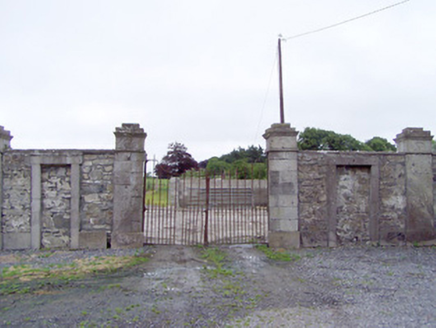
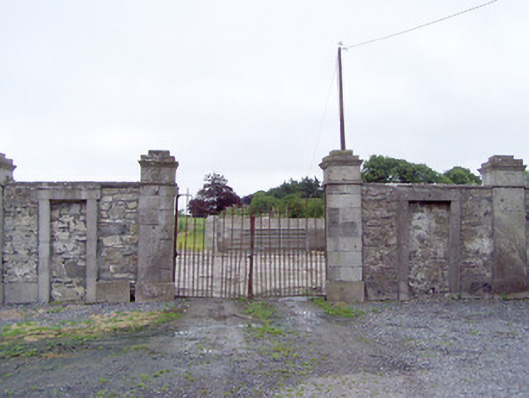
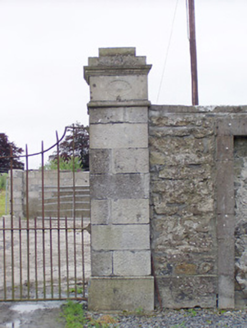
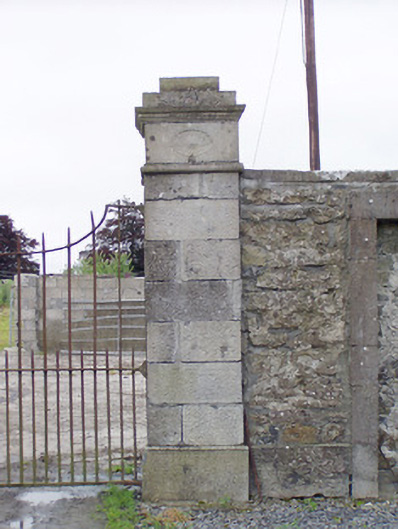
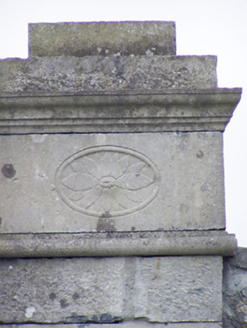
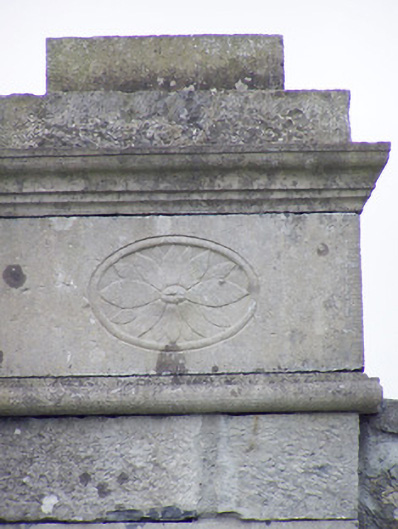
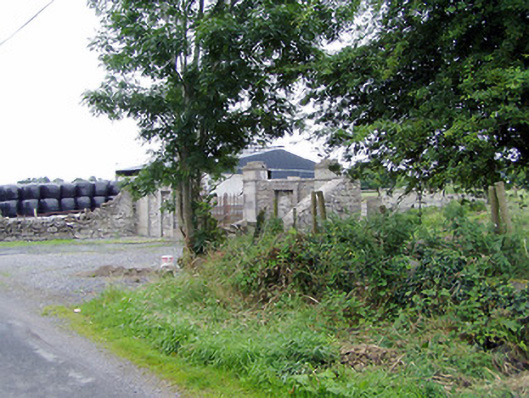
Gateway originally serving the north entrance to Newtownbond House, erected c. 1790. Comprising a central pair of ashlar limestone piers (on square-plan) having projecting dressed limestone plinths and carved stepped capstones over, and with moulded entablatures to heads having floral motifs set within roundels to frieze. Double-leaf wrought-iron gates with spear finials. Gateway flanked to either side (east and west) by sections of sections of rubble stone walling having cut stone plinth courses and cut stone coping over, an terminated to either side by ashlar limestone gateway piers of the same design as central piers. Integral square-headed pedestrian entrances to side walls having dressed limestone surrounds, entrances now blocked with rubble stone. Rubble stone boundary walls with tapered profile to either side of outer gate piers. Set back from road to the south of Ballinalee, and to the north of Newtownbond House (demolished).
Appraisal
This ornate classically-detailed gateway formerly served as the north entrance to Newtownbond House, now demolished. This gateway is particularly well-designed and is of apparent architectural merit, acting as a reminder of the former grandeur of the main house. The piers are solidly constructed and form a strong focal point which is offset by the finely sculpted limestone side entrances. The level of craftsmanship involved in the construction of these gates is of the highest quality, partially seen in the floral detailing to the friezes of the piers. The gates are a reminder of the skill of local stone masons and sculptors available in Ireland at the time of their construction. They provide important context to the locality and form an attractive roadside feature. The rubble stone walling to either side of the main entrance suggests that either these walls were rebuilt/remodelled or that that walls were originally rendered. Newtownbond House was a five-bay three-storey early-to-mid eighteenth-century house having a pedimented fanlight doorway. It was demolished at some stage during the second half of the twentieth century. The Bonds were Presbyterians from Yorkshire who settled in the north of Ireland during the mid-seventeenth century. One of them, Revd. James Bond, bought Newtownflood about 1729, renaming it Newtownbond, and reputedly built or rebuilt the Presbyterian meeting house at nearby Corboy (13401440). His fourth son, William (1750 - 1811), High Sheriff in Longford, commanded the Carrigglas Yeomanry during the rebellion of 1798, and, as agent to the Edgeworth family, supervised the building of the road from Edgeworthstown to Longford to the south. The estate remained in the Bond family throughout the nineteenth century. Henry Bond lived here in 1837 and 1846 (Lewis, Slater’s Directory), and Capt. William Bond was in residence in 1881 (Slater’s Directory).