Survey Data
Reg No
11902807
Rating
Regional
Categories of Special Interest
Architectural, Historical, Social
Original Use
Presbytery/parochial/curate's house
In Use As
Presbytery/parochial/curate's house
Date
1860 - 1900
Coordinates
276319, 207005
Date Recorded
23/10/2002
Date Updated
--/--/--
Description
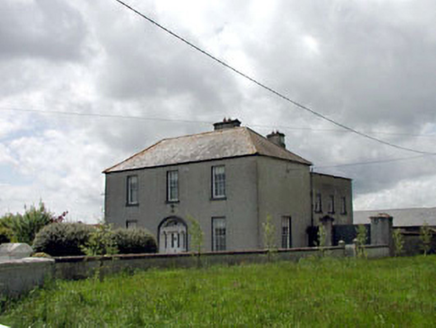
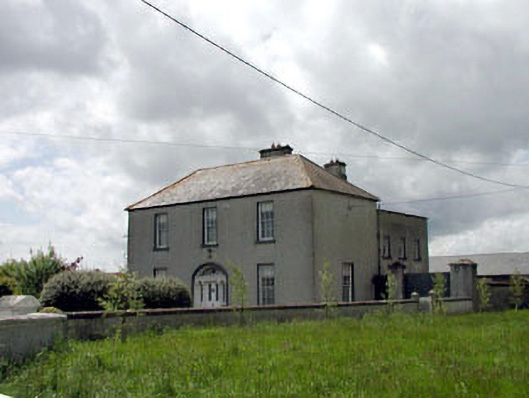
Detached three-bay two-storey parochial house, c.1880, retaining early fenestration with segmental-headed door opening to centre, three-bay two-storey return to rear to north-west having single-bay single-storey lean-to projecting bay and three-bay two-storey flat-roofed lower parallel return to rear to north-west. Reroofed, c.1970. Hipped roof (gable-ended to return; lean-to to projecting bay). Replacement fibre-cement slate, c.1970. Concrete ridge tiles. Rendered chimney stack. Cast-iron rainwater goods on eaves course. Flat-roof to parallel return. Replacement bitumen felt, c.1970. Roughcast walls. Unpainted. Square-headed window openings. Stone sills. 6/6 timber sash windows. 2/2 timber sash windows to parallel return. Segmental-headed door opening. Timber pilaster doorcase with consoles and entablature. Timber panelled door. Sidelights. Decorative fanlight. Set back from road in own landscaped grounds. Gateway, c.1880, to east comprising rendered piers with gabled capping having cast-iron gates.
Appraisal
Suncroft Parochial House is a fine and well-maintained late nineteenth-century substantial residence that retains most of its original character. Built contemporaneously with the adjacent Catholic church (11902806/KD-8-06), the two buildings form a neat and compact group that comprises the ecclesiastical centre of the village of Suncroft - as such the parochial house is of considerable social interest. Composed of graceful proportions, the sombre entrance (south-east) front is centred around a fine segmental-headed door opening that contains a decorative doorcase and glazing. Many of the original features and materials remain in situ, including the early multi-pane timber sash fenestration to the majority of the house, with larger pane sash fenestration to the parallel return (which is possibly a later addition) - the retention of much of the original external aspect suggests that internal features of note may also survive in situ. The house is attractively set back from the road in its own ground and is announced on the road side by a decorative gateway of early surviving cast-iron gates.