Survey Data
Reg No
11902711
Rating
Regional
Categories of Special Interest
Architectural, Artistic, Historical, Social
Original Use
Church/chapel
In Use As
Church/chapel
Date
1835 - 1845
Coordinates
271677, 205853
Date Recorded
04/11/2002
Date Updated
--/--/--
Description
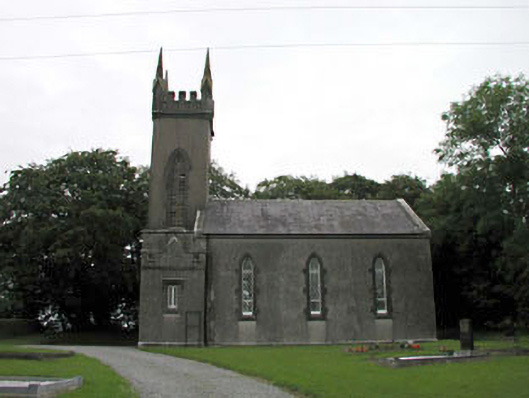
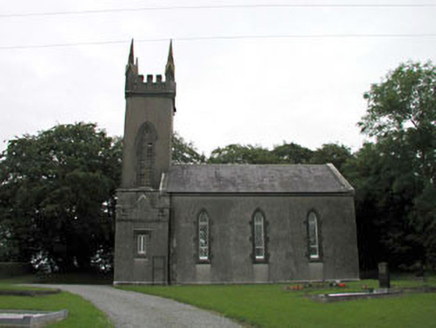
Detached three-bay double-height Gothic-style Church of Ireland church, built 1837-41, with lancet-arch openings and single-bay three-stage entrance tower to west having battlemented parapet and single-bay single-storey flanking bays including vestry projection. Gable-ended roofs with slate (behind battlemented parapet walls to tower and to flanking bays). Clay ridge tiles. Rendered coping to gables. Cast-iron rainwater goods on rendered eaves band. Roughcast walls. Unpainted. Battlemented roof parapets to tower and to flanking bays with rendered stringcourses and coping. Corner pinnacles to tower. Lancet-arch window openings (tripartite arrangement to east). Chamfered stone sills. Cut-stone block-and-start surrounds. Diamond-leaded traceried windows. Square-headed window opening to tower and to flanking bays. Cut-stone sills. Cut-stone hood mouldings. Fixed-pane timber diamond-leaded windows with lancet-arch panels. Pointed-arch door opening. Cut-stone chamfered surround. Timber panelled door. Set back from road in own grounds. Gravel forecourt to front.
Appraisal
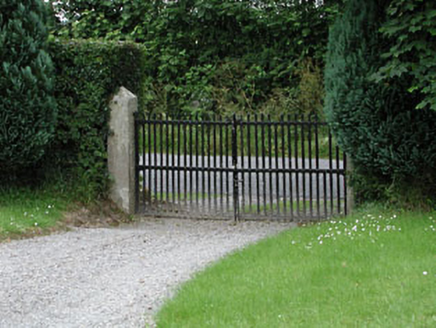
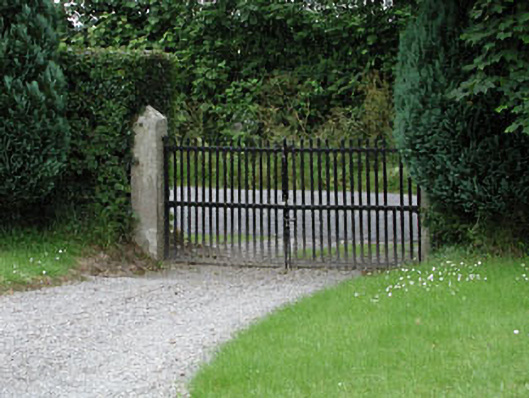
Nurney Church is an attractive building that was probably constructed on land donated by a local landlord, having been built in Nurney Demesne. The church has been well maintained over the years and retains much of its original character. Of a standard design, the church is identified by the three-bay nave with regular displacement of lancet-arch openings. Dominating the composition is the tall, slender entrance tower to west that is attractively flanked by squat bays, one of which contains the vestry accommodation. The tower serves to identify the church in the locality and adds a picturesque feature to the skyline, notably through the use of a battlemented parapet wall having slender corner pinnacles. The church retains much of its original features and materials, including fenestration and a slate roof, and the presence of an early external aspect suggests that an interior of note may also survive intact within. The church is attractively set in its own grounds and is surrounded by an attendant graveyard containing markers of various periods and of some artistic interest. Announcing the church on the side of the road is a pleasant and simple gateway, composed of monolithic piers with early surviving iron gates, and this forms a pleasant feature in the locality.