Survey Data
Reg No
11901805
Rating
Regional
Categories of Special Interest
Architectural, Historical, Social
Original Use
Presbytery/parochial/curate's house
In Use As
Presbytery/parochial/curate's house
Date
1850 - 1870
Coordinates
276648, 221677
Date Recorded
21/10/2002
Date Updated
--/--/--
Description
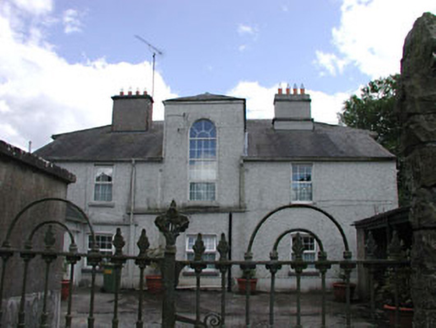
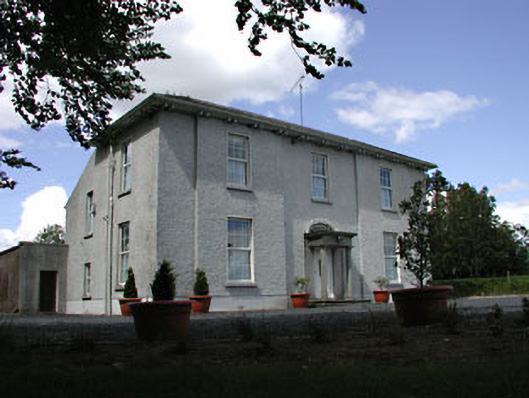
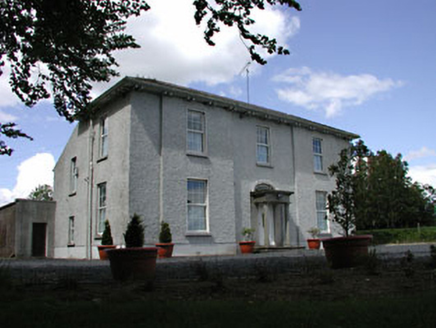
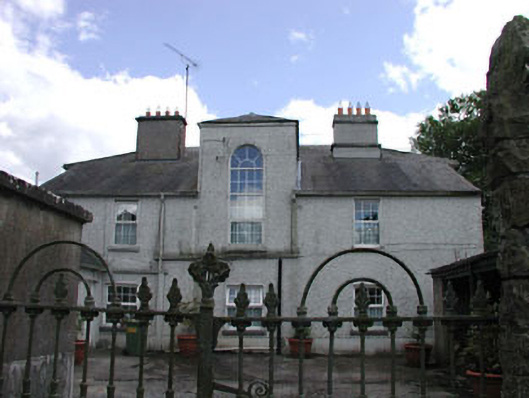
Detached three-bay two-storey parochial house, c.1860, with round-headed door opening to centre having cut-stone doorcase, advanced portions to flanking bays and three-bay two-storey lean-to lower range along rear elevation to west having higher bay to centre. Reroofed, c.1980. Refenestrated, c.1995. Hipped roof (lean-to to parallel range). Replacement artificial slate, c.1980. Concrete ridge tiles. Rendered chimney stacks (one re-rendered, c.1995). Overhanging timber eaves on paired brackets. Cast-iron rainwater goods. Roughcast walls. Unpainted. Square-headed window openings (round-headed to higher bay to rear to west). Stone sills. Replacement uPVC casement windows, c.1995. Round-headed door opening. Cut-granite columnar doorcase with entablature. Replacement glazed uPVC door, c.1995. Fanlight. Set back from road in own grounds. Gravel forecourt to front. Enclosed yard to rear with rubble stone boundary walls having cast-iron double gates.
Appraisal
Allen Parochial House is a fine and well-maintained mid nineteenth-century middle size residence of unusual appearance and graceful proportions. The regular entrance (east) front is composed on a symmetrical plan and, although without superfluous detailing, is enlivened by the central focus of the fine cut-granite doorcase that is complemented in the flanking bays by advanced portions to the window openings. To the rear (west) elevation an unusual feature is the central window opening to first floor that extends almost as a dormer attic window. The house, although altered, retains much of its original character and the re-instatement of timber fenestration would restore a more accurate representation of its original appearance. The house is of considerable social importance, retaining its original use, and forms an attractive group with the Catholic church nearby (not included in survey) that it serves and to which it acts as a foil in its simplicity. The parochial house is of some social and historic significance, representing the continued development of a Catholic presence in the locality in the mid nineteenth century. Attractively set in its own landscaped grounds, the house is a pleasant landmark in the locality. The gates to the yard to rear are important examples of early surviving cast-iron work.