Survey Data
Reg No
11901407
Rating
Regional
Categories of Special Interest
Architectural, Historical, Social
Original Use
Station master's house
In Use As
House
Date
1845 - 1850
Coordinates
294187, 228241
Date Recorded
15/10/2002
Date Updated
--/--/--
Description
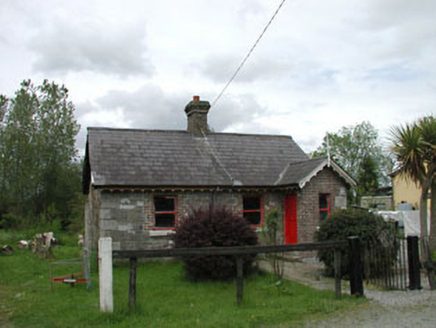
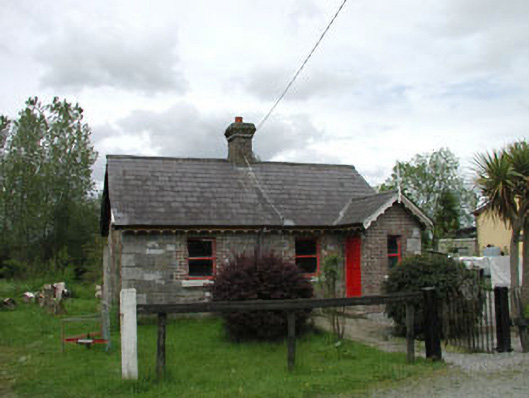
Detached three-bay single-storey limestone built former station master's house, built 1849, with single-bay single-storey gabled projecting porch to right. Closed, 1947. Extended, c.1980, comprising three-bay single-storey flat-roofed parallel range to rear to north. Now in private residential use. Gable-ended roof with slate (gabled to porch). Clay ridge tiles. Yellow brick chimney stack. Timber eaves and scalloped bargeboards. Cast-iron rainwater goods. Flat-roof to parallel range. Bitumen felt. Coursed snecked limestone walls. Cut-granite quoins to corners. Red brick Flemish bond walls to porch. Nap rendered to parallel range. Unpainted. Square-headed window openings. Stone sills (concrete to parallel range). Red brick block-and-start surrounds. 1/1 timber sash windows (timber casement windows to parallel range). Square-headed door opening. Tongue-and-groove timber panelled door. Set back from road in own grounds. Lawns to front with timber fence boundary.
Appraisal
Straffan Railway Station Master's House (former) is a fine, mid nineteenth-century domestic building on a small scale that has been well maintained to retain an early aspect. Yet, despite its small scale, the building is characterised by great visual interest as a result of the polychromatic juxtaposition of a variety of materials, including limestone, granite and red brick. Little surface area is left unornamented and includes scalloping to the timber bargeboards and eaves, while window openings are treated with block-and-start surrounds. Many original features and materials survive in situ, including early fenestration, a timber panelled door, and a slate roof, while later additions do not detract from the original character of the piece. The house is prominently set just off the side of the road and is an attractive feature in the area, grabbing the attention of the passer by, despite its diminutive scale, through the use of polychromy. Of historical and social importance, the house is a reminder of the railway network development in Ireland in the mid to late nineteenth century and also, on a smaller scale, a reminder of the former station at Straffan, which was closed in the mid twentieth century.